

Why Annual Audits Fail: The Case for Continuous Database Scanning
For decades, Software Asset Management (SAM) has been a reactive, annual event. Once a year, IT teams run collection scripts, compile software inventories, compare them against active entitlements, and attempt to resolve any license gaps.
But in modern, dynamic IT environments, annual SAM audits are obsolete.
Dynamic virtualization clusters, DevOps deployment pipelines, and cloud-native databases drift daily. Relying on an annual snapshot is a high-risk strategy that leaves organizations vulnerable to massive compliance penalties. Here is why manual, point-in-time scripting fails—and why continuous database scanning is the new standard.
⚡ The Failure of Point-in-Time Scripting
1. Configurations Drift Daily
In a virtualized cluster running Oracle, databases migrate between physical nodes. A developer might enable an extra-cost database option (such as Partitioning or Advanced Compression) for a quick test, intending to turn it off later.
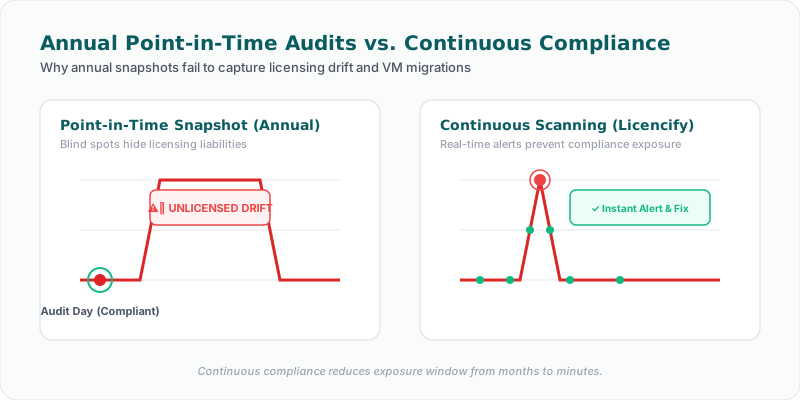
If this happens three months after your annual audit, that unlicensed feature will run undetected for nine months. When Oracle's auditors run their queries, they don't look at what you meant to do—they look at what was logged in the database, resulting in a retroactive licensing bill.
2. Infrastructure Changes Go Unmonitored
VMware DRS (Distributed Resource Scheduler) rules maintain compliance by confining VMs to licensed ESXi hosts. However, during server maintenance, clustering configurations can be modified. Without continuous monitoring, a disabled affinity rule can allow an Oracle database VM to migrate across your entire server farm, triggering license obligations for dozens of physical processors.
3. The "Gotcha" Audit Model
Oracle audits are designed to find compliance gaps at their peak usage. If you only baseline your environment once a year, you are flying blind for 364 days. You won't know you have a gap until the vendor's audit letter arrives.
🛡️ The Solution: Continuous Discovery and Baselining
To eliminate licensing risk, organizations must transition from reactive audits to continuous compliance scanning:
1. Real-Time Configuration Auditing: Run automated, lightweight scanning agents that query database options, processor counts, and VM placements daily.
2. Instant Option Alerts: Configure alerts to notify database administrators the moment an unlicensed feature (e.g. Active Data Guard) is activated, allowing you to disable it before it becomes a permanent liability.
3. Active Virtualization Tracking: Monitor DRS clusters and host boundaries continuously to ensure VMs remain restricted to licensed physical hardware.
🚀 How Licencify Protects Your Estate
Licencify replaces manual audits with continuous, secure scanning. Our local Collector runs in the background, auditing database feature usage and VM layouts across your entire infrastructure. If an unlicensed database pack is triggered or a VM crosses a cluster boundary, Licencify alerts your ITAM team within hours, giving you the visibility to correct the issue immediately and keep your estate permanently audit-ready.
Want to move away from reactive SAM? Schedule a demo of Licencify's continuous scanning platform today.
Facing an active Oracle or SQL Server Audit?
Verify database parameters and virtualization host boundaries locally without raw data uploads. Download our secure gateway.