

Logistics Fleet Compliance: How a European Leader Saved €1.2M on Database Licensing
Meta description: Discover how a major logistics enterprise isolated virtualization clusters and automated evidence collection to resolve a €1.2M Oracle licensing risk.
Suggested slug: oracle-licensing-logistics-case-study
⚡ The Challenge: Dynamic Clusters and High-Velocity Shipments
In the logistics and supply chain sector, uptime is everything. A major European transport leader, operating a fleet of over 5,000 delivery vehicles, relied on core Oracle databases to coordinate dispatch schedules, route optimizations, and real-time package tracking.
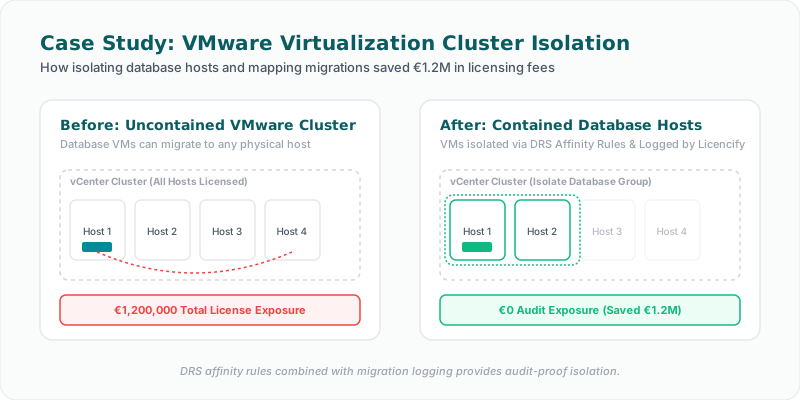
To guarantee high availability, their infrastructure team hosted these databases on a large, dynamic VMware vSphere cluster. If a host failed, VMware’s Distributed Resource Scheduler (DRS) and High Availability (HA) features would automatically migrate the database VMs to other physical hosts to keep the dispatch systems running.
However, this dynamic operational flexibility created a massive, hidden financial risk:
The Virtualization Trap: In an Oracle audit, the vendor often claims that if a database VM can* migrate to a physical host, that host must be fully licensed.
* The Spreadsheets Gap: The company’s Software Asset Management (SAM) team relied on manual, quarterly scripts and spreadsheets. They had no historical log of where database VMs had actually run over the past two years.
* The Triggered Features: During a routine system upgrade, a DBA temporarily activated a database partitioning pack for testing. It was never disabled, leaving a high-cost license liability running silently in the background.
With a pending vendor license review, the company faced a potential retroactive licensing exposure of €1.2M.
🛡️ The Turning Point: Moving Beyond Point-in-Time Audits
The logistics company realized that static spreadsheets and quarterly inventories could not keep pace with their dynamic infrastructure. They needed continuous, automated technical evidence to prove VM boundaries and database configurations.
They deployed Licencify's agentless collector across their vCenter and database instances. Within 48 hours, Licencify automated the collection of the three essential evidence chains:
1. Virtualization Topology Mapping: Mapping the precise clusters, host affinity rules, and physical CPU core counts.
2. Historical VM Migration Logs: Capturing a time-stamped history of every database VM’s physical host location over time.
3. Database Feature Auditing: Scrutinizing the active database options and management packs to identify unused but enabled features.
🚀 The Solution: Restricting Clusters and Disabling Unused Options
By combining database and virtualization evidence, Licencify provided the company's SAM and infrastructure teams with a clear roadmap:
1. Hardening VMware DRS Rules
Licencify mapped the vCenter and highlighted that while DRS affinity rules were intended to confine Oracle VMs to a sub-cluster of 4 physical hosts, a configuration error during a previous maintenance window had disabled these rules. This allowed the VMs to migrate across all 16 hosts in the server farm.
The team immediately re-enabled and hardened the affinity rules, restricting the database VMs to the licensed hosts.
2. Eliminating Feature Creep
Licencify’s feature auditing identified that the Oracle Partitioning option was active on two development databases but had not recorded any actual queries for 180 days. The DBAs quickly deactivated the unused feature, removing a €180,000 compliance liability.
3. Creating the Audit Evidence Pack
Instead of scrambling to write manual scripts for the vendor audit, the team exported a pre-validated, time-stamped Audit Evidence Pack from Licencify. This report provided the historical evidence verifying that the databases had been restricted to the designated sub-cluster and that configuration anomalies were corrected instantly.
📊 The Business Outcome: €1.2M Saved and Continuous Compliance
By transitioning to continuous scanning and automated evidence baselining, the logistics enterprise achieved major operational and financial results:
* €1.2M in Cost Avoidance: Proactively resolved the virtualization drift and deactivated unused packs before the formal vendor audit commenced.
* 100% Audit Readiness: Replaced manual scripting cycles with a continuous, automated evidence history.
* Zero Performance Impact: The agentless collector queried the systems read-only, ensuring no disruption to the 24/7 package dispatch and routing databases.
📌 Key Takeaways
* Dynamic Clusters Require Dynamic Tracking: You cannot manage dynamic VMware environments with static spreadsheets. Continuous historical tracking of VM locations is vital.
* Catch Configuration Drift Early: Unused database options or disabled affinity rules can cost hundreds of thousands of Euros if left unchecked until an audit.
* Bridging the Team Gap: Aligning DBAs (who understand database features) and Infrastructure Teams (who understand clusters) onto a single platform is the fastest path to compliance.
🔗 How Licencify Helps
Licencify helps organizations replace manual spreadsheets with continuous, technical evidence for database license management. If your business runs databases on virtualized infrastructure, Licencify provides the visibility you need to keep configurations optimized and remain permanently audit-ready.
Interested in baselining your database estate? Learn more about our continuous scanning platform.
⚖️ Disclaimer
This article is for informational purposes only and does not constitute legal or licensing advice.
🔗 Suggested Internal Links
* Why Database Licensing on VMware Requires Infrastructure Mapping
* Understanding DBA Feature Usage Statistics in Database Audits
* The Hidden Risks of VMware ULA Certifications
* Why Manual Database Licensing Scripts Fail
* How to Build a Technical Evidence Chain for Compliance
❓ FAQ
1. Why does VMware virtualization create licensing risks with Oracle?
Oracle’s standard policy does not recognize soft partitioning (like VMware DRS rules or VM isolation) as a method to limit license liability. They often demand licensing for all physical cores in a vCenter. Proving boundaries requires highly detailed, continuous migration history and configuration evidence.
2. What is an Oracle Database "Option" and why is it a risk?
Options (like Partitioning or Advanced Compression) are extra-cost features built into the database engine. They are easily activated (sometimes automatically by application scripts) but require expensive additional licenses if they remain active.
3. How often should database compliance be scanned?
Rather than quarterly or annually, scanning should be continuous or daily. Virtualized workloads and database configurations can change overnight, exposing you to licensing risks for months before manual audits detect them.
4. Does continuous scanning impact database performance?
No. Licencify runs agentless and read-only, querying lightweight metadata tables without placing a heavy CPU load on the active transaction engines.
5. Can we use this evidence to negotiate with vendors?
Yes. Having automated, time-stamped logs of your virtualization topology and feature usage provides a reliable technical foundation during contract negotiations and audits.
Facing an active Oracle or SQL Server Audit?
Verify database parameters and virtualization host boundaries locally without raw data uploads. Download our secure gateway.