

Oracle Database on Nutanix AHV & Proxmox VE: The KVM Licensing Trap
As virtualization technology has matured, many organizations are migrating workloads away from VMware vSphere. Two of the most popular alternatives are Nutanix AHV (which runs on a customized KVM hypervisor) and Proxmox VE (an open-source virtualization platform based on KVM).
However, migrating your Oracle Databases to these platforms without understanding Oracle’s strict virtualization policies can result in disastrous audit penalties.
Oracle treats Nutanix AHV and Proxmox VE as "Soft Partitioning" technologies, meaning they do not recognize them as valid methods to limit the number of database licenses required.
Here is what you need to know about the KVM licensing trap and how to design a compliant infrastructure.
⚠️ The Soft Partitioning Rule: Full-Cluster Licensing
Under Oracle’s Partitioning Policy, virtualization technologies are split into:
1. Hard Partitioning: Approved methods to limit the CPU cores that Oracle software is allowed to use (e.g., IBM LPAR, Oracle Solaris Zones, or Oracle Linux KVM with strict CPU pinning).
2. Soft Partitioning: Disallowed methods that cannot be used to limit licenses (e.g., VMware vSphere, Nutanix AHV, Proxmox VE, Microsoft Hyper-V).
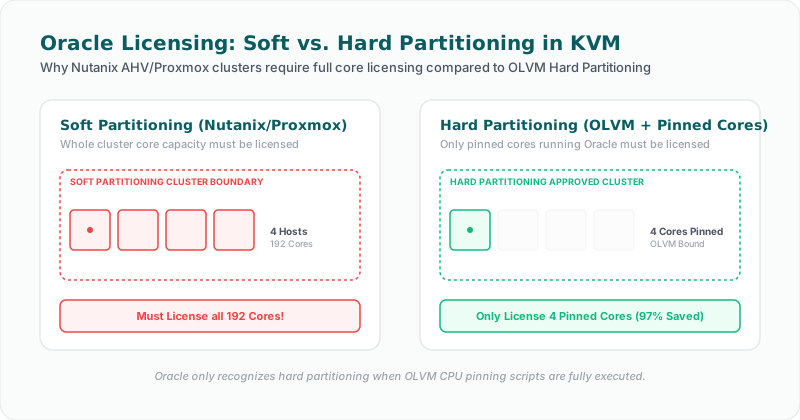
When running Oracle Database on a soft partitioning hypervisor, Oracle’s default audit stance is simple: you must license every physical core on every host in the entire hypervisor cluster.
If you have a 10-node Nutanix AHV cluster with 48 cores per node (480 total cores), and you run a single virtual machine (VM) with a 4-core Oracle Database on just one host, Oracle LMS (License Management Services) will demand licenses for all 480 physical cores.
At list prices, this could escalate a simple database setup into a multi-million dollar compliance nightmare.
🔍 The Exceptions: When is KVM Allowed?
Oracle does recognize KVM virtualization under very specific circumstances: Oracle Linux KVM combined with Oracle Linux Virtualization Manager (OLVM).
Under Oracle’s hard partitioning guidelines, you can limit your license footprint on Oracle Linux KVM if and only if you:
* Use physical CPU pinning to bind virtual CPUs (vCPUs) to specific, dedicated physical cores.
* Do not enable live migration (like vMotion or KVM Live Migration) for those VMs, since moving a VM to another host violates the hard partitioning rules.
* Document and report the pinning configurations during audits.
Crucially, this exception does not apply to Nutanix AHV or Proxmox VE. Because they are not Oracle Linux KVM/OLVM, Oracle does not contractually recognize CPU pinning or host affinity rules on these platforms as hard partitioning.
🛡️ Containment Strategies for Nutanix and Proxmox
If your organization is committed to using Nutanix or Proxmox, you can still run Oracle Databases without licensing your entire infrastructure, but it requires careful design:
1. Compute-Isolated Clusters
The safest strategy is to build a dedicated, physical cluster solely for Oracle workloads.
* For Nutanix: Create a small, dedicated Nutanix cluster (e.g., 3 nodes) for all database VMs. You must license all physical cores in this smaller cluster, but you completely isolate your larger application clusters from licensing liability.
* For Proxmox: Group dedicated hosts into a separate Proxmox pool and do not allow database VMs to reside on or migrate to the general-purpose pools.
2. Nutanix Storage-Only Nodes
Nutanix allows you to configure "Storage-Only" nodes. These nodes participate in the storage fabric but do not run the hypervisor or host VMs. Because Oracle software cannot run on these nodes, they do not require Oracle licenses. This is an effective way to scale storage without inflating software costs.
3. Hardened VM Host Affinity Rules
While Oracle auditors officially state that host affinity rules are not recognized, the literal text of the Oracle Master Agreement (OMA) defines licensed processors as where the software is "installed and/or running."
By configuring strict, non-automatic host affinity rules that pin database VMs to specific hosts, and maintaining pristine system logs proving the VMs never drifted to other hosts, organizations have successfully defended their licensing positions during audits.
🚀 Automating KVM Compliance with Licencify
Manually tracking virtual machine migrations, cluster membership, and CPU allocations in dynamic Proxmox or Nutanix environments is prone to error. One accidental live migration can trigger massive audit exposure.
Licencify provides continuous, automated virtualization scanning:
* Hypervisor Integration: Automatically connects to Proxmox VE and Nutanix AHV cluster APIs.
* Affinity and Pinning Verification: Detects host affinity rules and monitors VM placements in real-time.
* Compliance Alerts: Instantly alerts database administrators if an Oracle VM migrates to an unlicensed host, preventing point-in-time audit traps.
* Audit-Ready Logging: Generates historical proof of where database instances were installed and running, providing a robust defense during Oracle audits.
Planning a migration from VMware to Nutanix or Proxmox? Schedule a call with Licencify's database licensing architects to design a compliant, cost-optimized cluster today.
Facing an active Oracle or SQL Server Audit?
Verify database parameters and virtualization host boundaries locally without raw data uploads. Download our secure gateway.