

The 2026 State of ITAM: Why Tools Alone are Failing the Visibility Challenge
The results of the Flexera 2026 State of ITAM Report are official, and they reveal a glaring paradox in modern IT asset management:
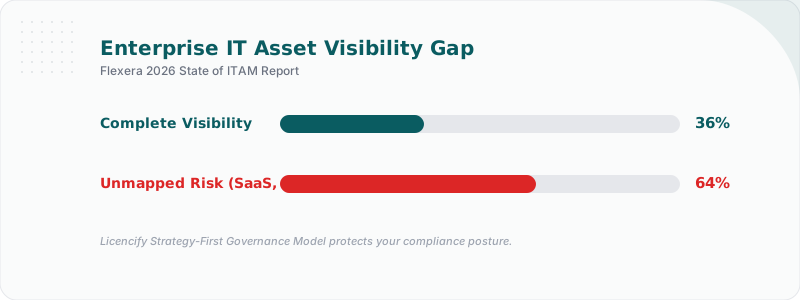
Organizations are spending more money, hiring more experts, and deploying more scanning tools than ever before—yet complete IT asset visibility has actually declined to just 36% (a 7-percentage-point drop year-over-year).
At the same time, the pressure from external software audits remains intense:
- 48% of enterprises received a formal software audit in the last year alone.
- 44% of organizations have spent more than $1 million on vendor audits over the past three years.
- Microsoft (64%) and Oracle (50%) remain the most active auditors.
If audit defense is a top priority, why is visibility going backward?
The SaaS and AI "Shadow IT" Wave
The decline in visibility isn't because asset managers are failing; it is because the IT estate is expanding faster than traditional governance models can adapt.
The rise of pay-as-you-go (PAYG) SaaS and generative AI software has created a secondary "shadow IT" environment that bypasses central IT procurement completely:
- 84% of ITAM professionals cite tracking or adopting new AI applications as a top challenge.
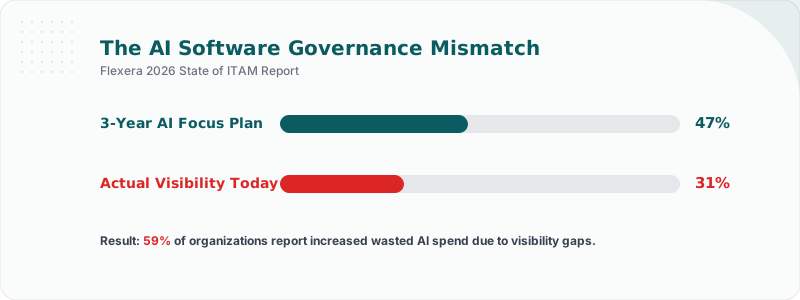
- 59% of organizations say wasted AI spend is rising.
- Yet, only 31% claim they actually have visibility into AI software running in their estate today.
This is a carbon copy of the early days of SaaS adoption, but moving at warp speed. Organizations are experimenting with AI models and cloud databases without establishing a clear governance framework first. By the time the vendor audit letter arrives, the compliance liability is already baked in.
The Tooling Trap: Why More Software Isn't the Answer
When faced with a decline in visibility, the instinctive corporate response is to buy a broader, more expensive Software Asset Management (SAM) tool.
But a tool is only as good as the governance processes feeding it. Broad SAM suites excel at general-purpose scanning, but they often struggle with the "last mile" of complex database configurations, cluster boundaries, and virtualization use rights.
For instance, scanning a virtualized VMware cluster for Oracle database options using basic file-scanning methods often results in:
- High rates of false positives (or worse, false negatives).
- Complex scripting requirements that demand hundreds of manual DBA hours.
- A lack of explainable, audit-ready data.
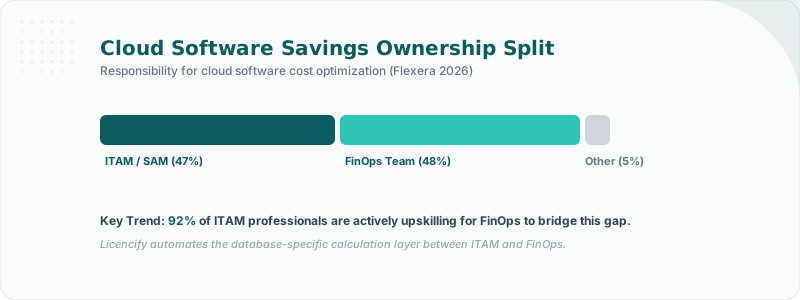
This is where the boundaries between ITAM and FinOps start to blur. In fact, the report shows that responsibility for public cloud software savings is now nearly split: 47% of organizations place public cloud software savings under ITAM/SAM teams, while FinOps teams lead the rest.
Building a "Strategy-First" Governance Foundation
To reverse the visibility deficit and build a reliable audit defense, organizations must shift from a tool-centric model to a strategy-first governance model.
Here are three steps to establishing a mature compliance program:
1. Align ITAM and FinOps Roles
With 92% of ITAM professionals now upskilling for FinOps, the lines between license management and cloud consumption are permanently crossed. Establish a unified governance framework that combines ITAM's license intelligence (like Bring-Your-Own-License/BYOL rules) with FinOps' real-time cloud tracking.
2. Implement Local, Database-Aware Discovery
General-purpose SAM scanners often fail to verify database parameters and virtualization host boundaries. Use specialized, database-aware utilities that can scrub and analyze licensing parameters locally. This ensures your compliance calculations are explainable and audit-proof before vendor scripts are run.
3. Reclaim SaaS and AI Waste
Rather than waiting for renewal cycles, implement automated workflows to continuously reclaim unused SaaS seats and track AI application usage fields directly within your configuration management database (CMDB). Currently, only 32% of organizations track AI applications in their CMDB.
How Licencify Can Help
At Licencify, we build the governance and data foundation that makes your broader SAM tool implementations (like Flexera, ServiceNow, or Snow) actually succeed.
Instead of requiring raw data uploads to third-party servers, our local gateway scrubs and maps complex database configurations on-premises. This gives your team an explainable, independent compliance benchmark for Oracle, Microsoft SQL Server, DB2, and SAP—allowing you to rightsizing your licensing contracts and confidently face vendor audits.
Want to check your audit readiness? Talk to one of our licensing architects to audit your structural maturity before the next audit notice arrives.
  Facing an active Oracle or SQL Server Audit?
Verify database parameters and virtualization host boundaries locally without raw data uploads. Download our secure gateway.